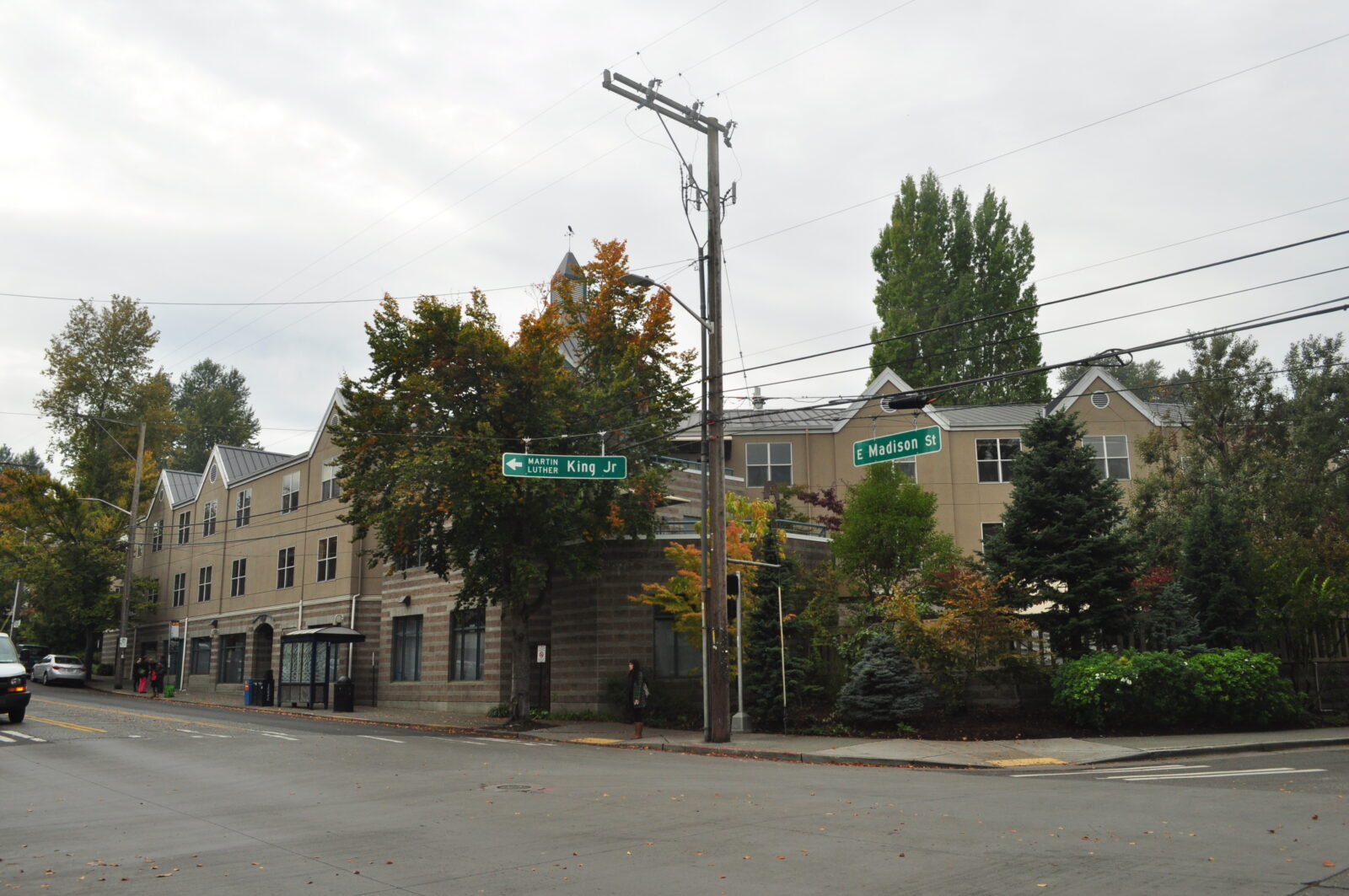
Madison Valley Homeless Shelter Brings Crime and Disorder to Neighborhood
Wendy Yim is an aspiring writer, and by all measures a good one. Her first novel attracted the attention of literary agents and she was working on a second when she was forced to pivot to much less rewarding work: defending her neighborhood against the dangers posed by a low-barrier homeless shelter.
Wendy’s family lives in Seattle’s picturesque, middle-class Madison Valley neighborhood, situated just east of Capitol Hill — a place filled with eclectic and colorful homes, winding streets lined with trees, and yards landscaped with flowers.
Through the middle runs East Madison Street, host to about twenty small businesses, including a flower shop, bakery, music school, several ethnic restaurants, a small supermarket, and a massage clinic. Children make up 20% of the neighborhood demographic, and there’s a fresh new playfield at nearby Washington Park, home to Seattle’s gorgeous arboretum.
Unfortunately, behind this pleasant scene lurks increasing danger.
Residents Suffer Violence and Disorder
“Madison Valley residents, merchants, and visitors have lost their sense of safety in this community,” said Wendy. “There’s drug-selling and use, people laying or sitting on the sidewalks, overdoses, and a constant stream of people coming and going from the local shelter right into the trees and tent encampments at our public parks.”
Recently, on a public path at the park, Wendy found a full bottle of anti-psychotic medication belonging to a patient just discharged from Harborview Medical Center. Another day, she spotted a man in full hunting gear, face obscured, wearing a gun holster and sitting in the bushes overlooking the children’s playfield. Yet another time, she was accosted while walking home from the local pet store by an erratic and aggressive man who approached her yelling, “Lady! Hey, Lady!” She fled.
Ruth Dalton couldn’t run away. The 80-year-old grandmother and professional dog-walker was murdered in Madison Valley in 2024 by a violent, eight-time felon and former psychiatric patient. Within sight of the nearby homeless shelter, he carjacked Ruth, ran her over, and then stabbed her little dog to death.
Wendy’s across-the-street neighbor decided to move his family out of Madison Valley after he and his children were threatened in March by a deranged man, likely high on meth, who entered their yard and yelled about killing the neighbor and taking his children. The man then ripped a metal street sign out of the ground and brandished it before walking back into the nearby shelter.
In 2022, a businesswoman in Madison Valley was violently assaulted in her shop by another homeless man under the influence of drugs — also a repeat offender and out on Department of Corrections work-release. Witnesses report that the man also entered the homeless shelter after the attack, and staff then prevented police from entering.
Incidents All Tied to Homeless Shelter
The shelter at the center of these incidents is owned by a multi-billion-dollar out-of-state nonprofit called CommonSpirit Health, and is operated locally by its subsidiary, Virginia Mason Franciscan Health. The shelter is situated right in the heart of the Madison Valley neighborhood, in a facility called Bailey-Boushay House that was originally opened in 1992 to provide a place of peace and hospice for HIV/AIDS patients. As that disease became treatable and the need for hospice decreased, Bailey-Boushay in 2018 converted some of its space to a fifty-bed, low-barrier overnight homeless shelter.
Since then, the facility has received millions in city funding each year to operate that shelter, which sits at the end of a Seattle Metro line and attracts hundreds of homeless individuals. Many suffer from mental illness and substance abuse and spend their days wandering in the neighborhood or nearby parks, but the low-barrier approach that is a staple of the popular Housing First model means clients are not required to engage with treatment or case management for those conditions.
Bailey-Boushay’s own staff described in a December 2025 report that “in the last month alone, we have had two individuals detained against their will in inpatient psych, we have had property damage due to clients being suspended from the program, and two clients that died from a lethal overdose.” The report noted “an increase in Fentanyl overdoses,” to which staff responded by continuing “to provide Harm Reduction supplies…and teach on safer use practices.”
As open drug use, loitering, littering, erratic behavior, and crime have more visibly infected the neighborhood, it has become harder for Madison Valley residents to reach the shelter’s management. Wendy and her community have documented years of trying with no response.
Who’s Accountable?
Wendy’s goal has been to identify who is responsible for enforcing the required Good Neighbor Agreement (GNA), but, though such agreements are an often-touted part of the marketing when these facilities seek entry to a neighborhood, it seems no such document existed at Bailey-Boushay until neighbors finally garnered enough attention to force the issue last year. A 2026 report by King County’s Regional Homelessness Authority (KCRHA), the oversight agency on record, found “most of the facility’s staff were not aware of the GNA because there was nothing on their end to hold them accountable to it.”
Instead of partnering with neighbors to address concerns, Bailey-Boushay staff seem intent on thwarting their efforts. Police responding to calls at the shelter are frequently (and wrongly) told that HIPAA prevents sharing any information about possible suspects sheltering inside. Staff admitted in the December report that they work to prevent police “from running names when arriving on the scene to overdoses.”
Wendy reports: “Bailey-Boushay House leadership has told us that once their residents are outside their doors, it’s not their problem to deal with. That leaves private citizens to bear the burden brought by a company that’s profiting from homelessness.”
King County Homeless Authority Investigates
In the past year, Madison Valley neighbors reached out to the King County Regional Homelessness Authority to request an investigative review of the Bailey-Boushay’s Good Neighbor Agreement and related issues. The results of that investigation were released in March 2026, and the agency’s ombudsmen concluded first that Bailey-Boushay’s management did not comply with the GNA, and second that staff applied GNA terms inconsistently when they engaged with neighbors and law enforcement.
More generally, the KCRHA investigation concluded that “existing guidance and intergovernmental capacity to oversee and support GNAs are insufficient, leaving agencies and stakeholders without enough resources or direction.”
With similar issues plaguing other homeless housing buildings, tiny home villages, and shelters around the state, many citizens are voicing concerns and questions about Seattle Mayor Katie Wilson’s plan to place 500 new tiny housing units around the city in the coming weeks, and how she will ensure accountability for community safety as well as client support services.
Councilmember Hollingsworth Demands Answers, Reforms
In Madison Valley, Wendy Yim is hopeful her local councilmember, Seattle City Council President Joy Hollingsworth, will help bring accountability to the Bailey-Boushay. After meeting with Wendy and other neighbors, Hollingsworth sent a letter to leadership at CommonSpirit Health, the quasi-national nonprofit that owns the facility, which is operated by its subsidiary Virginia Mason Franciscan Health.
Hollingsworth’s letter, dated April 21, gives CommonSpirit 30 days to “provide a detailed implementation plan…that outlines specific actions, responsible parties, and milestones” to improve security inside and outside the building and address discharge plans and follow-up for clients.
Hollingsworth makes her own specific recommendations, including 24/7 security inside and outside the building, with perimeter checks and visible patrols in nearby blocks. She wants management to provide a 24-hour phone line for neighbors, staffed by a live representative with authority to dispatch on-site support and coordinate with local service providers. And she calls for an active email response and regular meetings with security leadership and neighbors.
Further, Hollingsworth addresses concerns with the shelter’s discharge practices. “There are documented instances of individuals being discharged and remaining in the neighborhood while in distress and sometimes exhibiting behaviors that raise safety concerns, including interactions near daycare centers, public substance use, and unmanaged mental health challenges that create a threat to the neighborhood.”
Hollingsworth wants facility staff to “ensure all discharge plans include confirmed transportation to a safe, appropriate, and pre-identified destination,” and to develop “individualized” plans that address “behavioral health, substance use, and safety considerations.” She wants staff to coordinate with other service providers to ensure continuity of care.
Commonsense Reforms
Every homeless housing facility should heed these common-sense recommendations. Until they do, a growing number of Washingtonians like Wendy are forced to invest outlandish amounts of personal time and money — and irreplaceable emotional and intellectual resources and potential — trying to defend their homes, families, and businesses against these destructive homeless policies.
Virginia Mason and CommonSpirit Ignore Requests for Comment
An email and voicemail requesting comment from CommonSpirit’s media team went unanswered. A spokeswoman for Virginia Mason asked where this story might be published, then did not respond again. The author has contacted KCRHA to ask about the next steps in enforcing the Good Neighbor Agreement.
Readers interested in hearing from Madison Valley’s neighborhood team directly can visit mvrams.net.