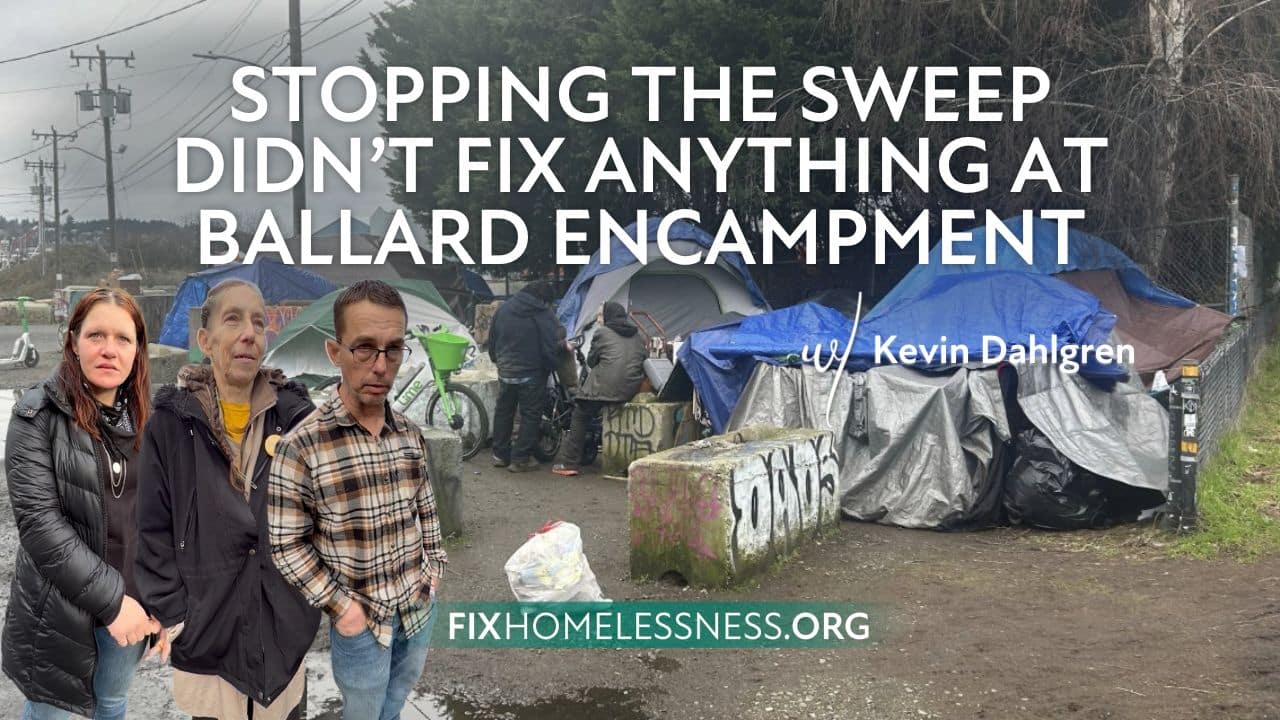
Stopping the Sweep Didn’t Fix Anything at Seattle’s Ballard Encampment
- Categories
- Governance
- Homelessness
- Street Report
I went to the Ballard homeless encampment that has been dominating Seattle headlines, and what I found there was not clarity or compassion colliding with cruelty, but a system quietly failing almost everyone involved.
Business owners and nearby residents are frustrated and exhausted. They’ve watched the encampment grow while public spaces deteriorate and safety concerns mount. On the other side, homeless advocates are fiercely defending the right of people to remain where they are, arguing that sweeps only deepen trauma and solve nothing. Caught in the middle is a city trying to signal change under new leadership, while offering very little evidence that real change is actually happening.
This encampment was scheduled to be swept, but Mayor Katie Wilson halted those plans. Rumors are already circulating that she may move to stop all sweeps citywide, making this a significant early test of her administration. During her campaign, she consistently avoided answering a simple but crucial question: should people be allowed to live in parks? Standing at this encampment, she said her team is conducting a “thorough review” of Seattle’s homeless response. That phrase has become familiar in this city, and it rarely signals urgency.
I spoke with several people living at the encampment. One man told me he has been there for three years. In that time, he says, he has never received real help. He recalls being offered shelter once, but it would not accommodate both him and his daughter. Faced with the choice of separating from his child or remaining outside, he chose the latter. He is relieved that the sweep was stopped, but deeply disappointed in the social service system that claims to exist for people like him. His frustration wasn’t angry or performative. It was weary.
A woman living nearby said she has never been approached by outreach workers or offered help of any kind. No housing navigation, no case management, no meaningful engagement. Just time passing, tents aging, and lives slowly hardening around survival.
Another man, who has been in the encampment for a long time, told me plainly that he doesn’t really want to live indoors. He prefers being outside and does not see housing as something he wants. He represents a reality that rarely gets discussed honestly: some people experiencing homelessness will not accept housing, no matter how much is built. This does not make them villains, but it does mean that housing alone is not a comprehensive solution, no matter how often politicians repeat that it is.
I also spoke with the Transit Fairy, a close ally of the mayor and one of the founders of the Transit Riders Union alongside Mayor Wilson and her husband. She even swore the mayor in at her inauguration. Despite our differences, we agreed on something rare in Seattle politics: everyone has to work together. Ideological purity and political posturing have accomplished nothing but paralysis. She wants to see major change in the next year, and so do I. Whether that hope translates into action remains to be seen.
What struck me most was not the decision to stop the sweep, but what did not follow. There was no visible increase in assertive outreach. No coordinated effort to engage every person living there with real options, hard conversations, and clear expectations. Stopping a sweep without immediately intensifying outreach is not compassion. It is abandonment with better optics.
Seattle’s social service system prides itself on its size, its funding, and its language. Yet here were multiple people, living in one of the most visible encampments in the city, saying they had never been meaningfully helped. That is not a funding problem. That is a functional failure.
We have created a system that manages homelessness instead of resolving it. We defend rights without enforcing responsibilities. We halt action without replacing it with anything effective. The result is a perfect storm: encampments remain, neighborhoods suffer, people living outside stagnate, and everyone grows more entrenched in their position.
It is one thing to oppose sweeps. It is another thing entirely to pretend that stopping them is a solution. If Mayor Wilson truly wants to change Seattle’s approach, the test is not whether she can pause enforcement. The test is whether she can demand results. Real outreach. Real engagement. Real accountability — for providers, for the city, and yes, for individuals.
Without that, this encampment is not a symbol of progress. It is a snapshot of dysfunction, frozen in place by good intentions and bad systems, waiting for leadership brave enough to do more than review the problem.
Follow Kevin:
X: https://x.com/kevindahlgren
Substack: https://truthonthestreets.substack.com