Beneath the Driftwood: One Homeless Man’s Underground Life
- Categories
- Drug Epidemic
- Homelessness
- Street Report
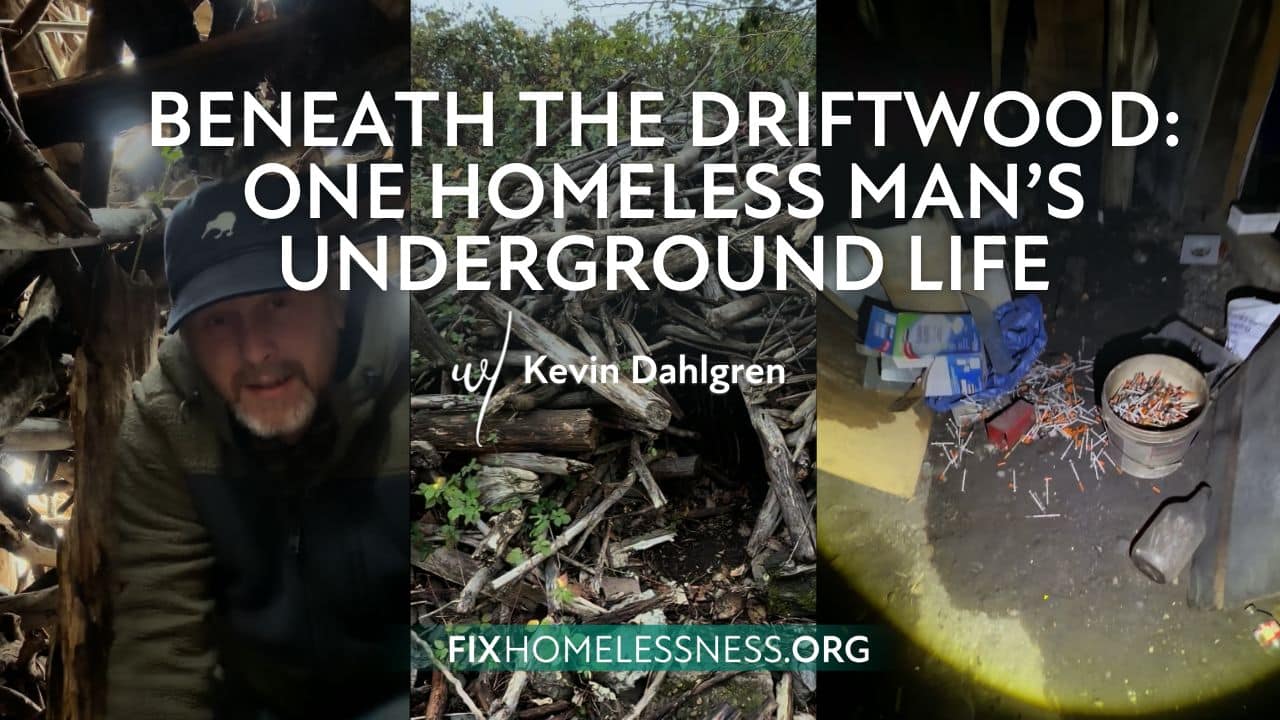
A homeless man has burrowed himself beneath thousands of pieces of driftwood and built what can only be described as an apartment. I went inside and looked around. There are two bedrooms, one still under construction, framed by uneven piles of driftwood and debris. Two small windows let in slivers of natural light through the gaps, barely illuminating the space. Shadows crawl across the walls and floor, giving the room a claustrophobic, almost surreal quality.
The living area is chaotic, more workshop than home. Boards, nails, and hand tools are scattered across the dirt floor, evidence of ongoing construction and repair. Among the clutter, hundreds of used needles glint dangerously in the dim light. The smell of damp wood and river water is thick, mixing with the metallic tang of rusting tools and the faint chemical odor of discarded substances.
Near the entrance, a makeshift bathroom waits: a toilet seat perched precariously over a hole roughly six feet deep. Every corner of the apartment tells a story of necessity and improvisation — walls built for shelter, furniture crafted from driftwood, spaces carved out by hands that have long known hardship. Despite the chaos, there is evidence of ingenuity. Shelves are stacked with cans, bottles, and scavenged supplies. A small table holds a makeshift cooking setup. In one corner, a partially built bunk hints at a plan for comfort or expansion.
This is not a home. It is a survival bunker — a place that protects, but also confines. Every step carries risk: the dirt floor is uneven, needles hide in shadows, driftwood stacks precariously overhead. It is both refuge and prison, a testament to resilience and a warning of what happens when society fails its most vulnerable.
From the outside, the location is breathtaking: he has a million-dollar view of the river. Across the water sit million-dollar condos. But inside, it is nothing short of a nightmare. Dark, cramped, hazardous — it feels more like a torture chamber than a home. This is not living; it is surviving.
He has been able to exist here for so long because he occupies a legal gray area. Responsibility for the land shifts with the tide, moving from one government entity to another. In effect, no one wants to own the problem, and he remains invisible — abandoned by the very system meant to protect him.
This is the natural outcome when a system fails. Portland spends $724 million a year on homelessness — more than $90,000 per homeless person annually — and yet homelessness has increased 61% over the last two years. Clearly, throwing money at the problem alone was never the solution. People are still living in these conditions. Scenes like this are not rare; this is one of a dozen driftwood “cabins” along the riverbanks. The numbers are staggering, but the human cost cannot be measured in dollars alone.
This is why President Trump’s “Ending Crime and Disorder on America’s Streets” matters. The executive order, signed this summer, finally acknowledges what many have ignored: the current approach is broken. It prioritizes enforcement, recovery, and accountability, moving away from “Housing First” models that provide shelter without requiring treatment or engagement. It empowers local governments to remove dangerous encampments, enforce anti-vagrancy laws, and intervene when addiction and mental illness make survival impossible.
Some will call this harsh. I call it necessary. Living like this is not a choice — it is a death sentence in slow motion. People cannot recover if they are forced to survive in tunnels of driftwood, exposed to the elements, needles, and disease. They need structure, help, and a path to self-sufficiency.
Ending Crime and Disorder on America’s Streets is not just policy; it is a lifeline. It has the potential to save thousands of lives — including those who do not yet want to be saved — because sometimes saving someone means making the hard choice for them. The status quo is cruel. We can do better. We must.
Follow Kevin:
X: https://x.com/kevindahlgren
Substack: https://truthonthestreets.substack.com